
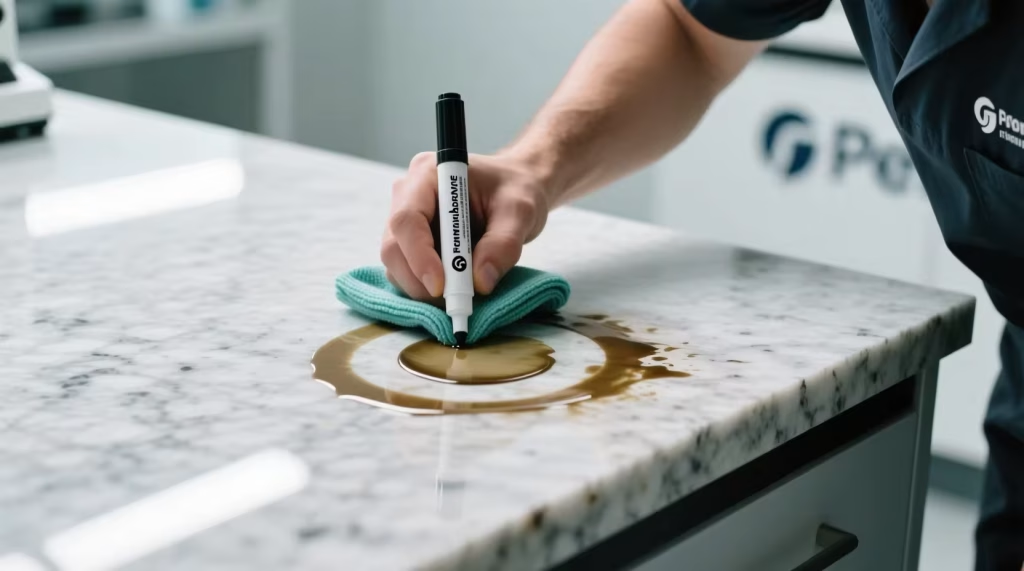
Nick from Jackson Stoneworks uncapped a permanent marker and drew directly on labeled quartz and granite samples in front of the camera. The results were honest. Moreover, the whole point of the test was to answer a question Jackson’s design team hears constantly: can quartz or granite actually be stained? Furthermore, quartz countertop myths about staining, heat, and durability are common enough that Jackson built a field test program to answer them with real results rather than manufacturer talking points. Here’s what the tests showed.
What the Permanent Marker Test Actually Showed
Nick applied permanent marker to both a quartz sample and a granite sample. Because the test was filmed on labeled stone rather than an installed countertop, the result was visible and undeniable: the marker left a clear mark on both surfaces. It didn’t wipe off with a dry cloth. Additionally, water alone didn’t clear it either. Consequently, the test confirmed what fabricators know but rarely demonstrate: permanent marker does stain both quartz and granite.
However, the follow-up matters as much as the result. Permanent marker on quartz responds well to isopropyl alcohol at 90% concentration or higher, applied with a soft cloth. Furthermore, acetone-based nail polish remover also lifts marker from quartz effectively. Moreover, granite responds to the same treatment. Acting quickly makes removal easier, but even dried marker comes off with the right product. The myth isn’t that permanent marker won’t mark the surface. Staining is not permanent once you know what product to use.
Four Quartz Countertop Myths the Tests Address
The permanent marker test is one demonstration in a broader field test series Jackson runs to answer real questions. The following four quartz countertop myths come up regularly in design consultations and deserve a straight answer.
Myth 1: Quartz Is Completely Stain-Proof
The non-porous structure of quartz makes it resistant to most kitchen spills. Liquids sit on the surface rather than absorbing into the stone. However, non-porous does not mean impervious to everything. Specifically, permanent markers, strong dyes, and certain food colorings can adhere to the resin binder that gives quartz its density. Furthermore, the longer they sit, the harder they become to lift. The accurate version: quartz resists almost every common kitchen stain well, but a handful of specific substances require prompt attention and the right cleaning product.
Myth 2: Quartz Handles Heat the Same as Granite
It doesn’t. According to Wikipedia, natural quartz is an extremely hard mineral. Engineered quartz slabs, however, include roughly 7% polymer resin that binds the stone particles together. Because that resin is sensitive to sudden extreme heat, placing a hot pan directly from a burner onto quartz can cause thermal shock. Consequently, the resin can crack or discolor at the contact point, and that damage is not reversible without professional repair. In contrast, granite is entirely natural stone with no polymer content, so it handles direct heat considerably better. The fix is simple: use a trivet every time, on quartz without exception.
Myth 3: Red Wine Will Permanently Ruin a Countertop
This one is overstated for quartz and situation-dependent for granite. Because quartz is non-porous, red wine sits on the surface rather than penetrating it. Moreover, a prompt wipe with a damp cloth clears wine from quartz without staining. For granite, the answer depends on whether the slab is properly sealed. Additionally, a well-sealed granite surface repels wine spills the same way quartz does. An unsealed or improperly sealed granite slab can absorb the liquid before it’s wiped up, which is the actual risk. Furthermore, the annual water bead test tells you exactly where a granite seal stands: if water absorbs within four minutes, it’s time to reseal.
Myth 4: You Can Skip Cutting Boards on Stone Countertops
Stone is harder than most knives, so it won’t crack or chip from normal cutting use. However, cutting directly on quartz or granite dulls knife edges faster than wood or plastic boards. Additionally, fine scratches from repeated cutting build up on the surface over time, gradually affecting the polished finish. Moreover, for marble countertops specifically, cutting directly causes visible scoring because marble is much softer than quartz or granite. Consequently, a cutting board is good practice on any stone surface. It protects your knives and your finish far more than it protects the stone.
| Field Test | Quartz Result | Granite Result | Fix |
|---|---|---|---|
| Permanent marker | Marks both surfaces | Marks both surfaces | Isopropyl alcohol 90%+ or acetone |
| Hot pan direct contact | Risk of thermal crack in resin | Handles heat well — no resin | Always use trivets on quartz |
| Red wine spill | Non-porous — wipes clean promptly | Depends on seal quality | Prompt cleanup; reseal granite as needed |
| Direct cutting | Dulls knife edges over time | Dulls knife edges over time | Use a cutting board on all stone |
| Permanent marker dried | Harder to remove but still cleanable | Harder to remove but still cleanable | Same products, more dwell time |
What the Tests Mean for Real Kitchen Care
The field tests don’t change how good quartz and granite are as countertop materials. They clarify which situations actually require attention and which don’t.
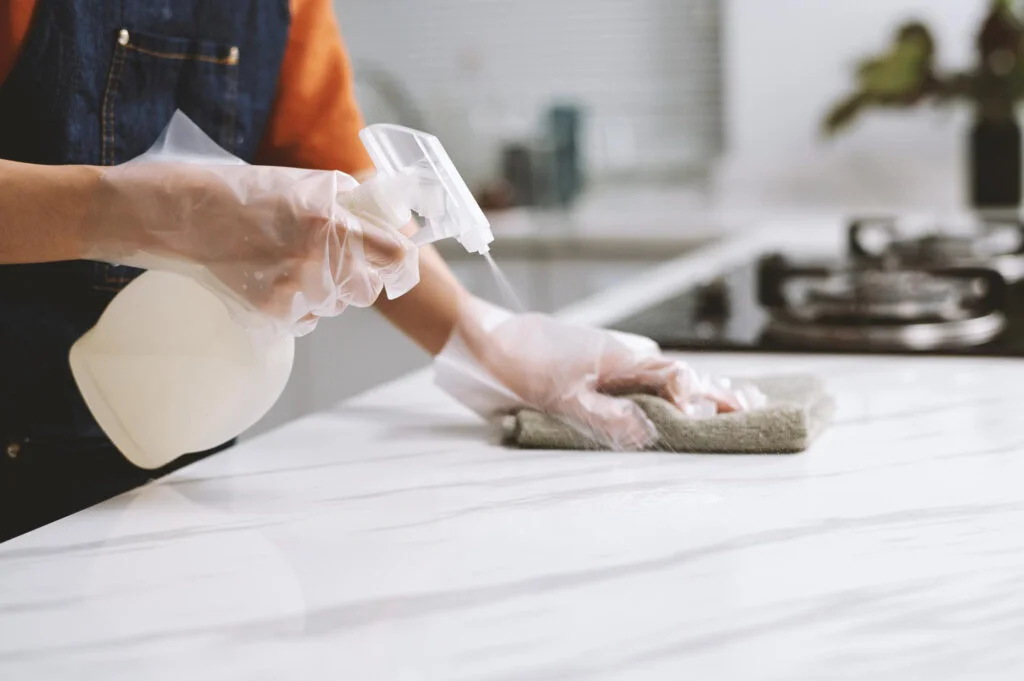
For quartz countertops: Daily care is genuinely minimal. Because quartz is non-porous, standard cleaning is a soft cloth and warm soapy water. Additionally, keep isopropyl alcohol under the sink for markers, inks, and any pigment-heavy spill that doesn’t wipe off normally. However, the two rules that matter most are consistent: never put hot cookware directly on the surface, and avoid abrasive scrubbing pads that dull the finish over time.
For granite countertops: The main variable is the seal. Specifically, a properly sealed granite surface resists normal kitchen use without any special daily routine. Moreover, the water bead test takes thirty seconds and tells you whether the seal is holding or due for a refresh. Furthermore, when it comes to heat, granite’s advantage over quartz is real — but trivets are still a good habit for protecting the finish on any stone surface regardless of material.
Frequently Asked Questions
Can permanent marker actually be removed from quartz?
Yes. Isopropyl alcohol at 90% concentration or higher removes permanent marker from quartz when applied with a soft cloth. Furthermore, acetone-based nail polish remover also works. Additionally, apply it directly to the affected area and let it dwell for thirty seconds before wiping. Moreover, fresh marker lifts faster, but dried marker responds to the same products with a bit more working time.
Why does Jackson run stone field tests?
Because homeowners make better decisions when they see real results rather than filtered claims. The field test series tests one variable at a time on labeled samples so the outcome is clear. Furthermore, when the result is unflattering, it still gets shared — the permanent marker test is proof of that. Consequently, the test program builds trust more effectively than any product description could, because the outcome isn’t edited for the best possible look.
Where can I see Jackson’s quartz and granite selection in person?
Jackson’s Gainesville showroom carries 300+ colors in-yard across quartz, granite, marble, and other materials. Additionally, the design team is on hand to answer care questions, discuss specific use cases, and pull samples that suit your project. Furthermore, the gallery shows finished installations so you can see how specific materials perform in real kitchen environments before committing.
See the Materials Behind the Myths
The quartz countertop myths above are common because the materials are misunderstood at the edges. Moreover, most countertop surfaces hold up well under normal use. The field tests just define where “normal” ends and where attention is actually needed. Furthermore, Jackson’s team answers these questions every day in the showroom, not from a script, but from running the tests. Consequently, a thirty-minute conversation at the Gainesville showroom answers more than a week of online research.
Book a free consultation or call 352-372-6600. Jackson Stoneworks is open Monday through Friday 8 AM to 5 PM and Saturday 9 AM to 2 PM.


