
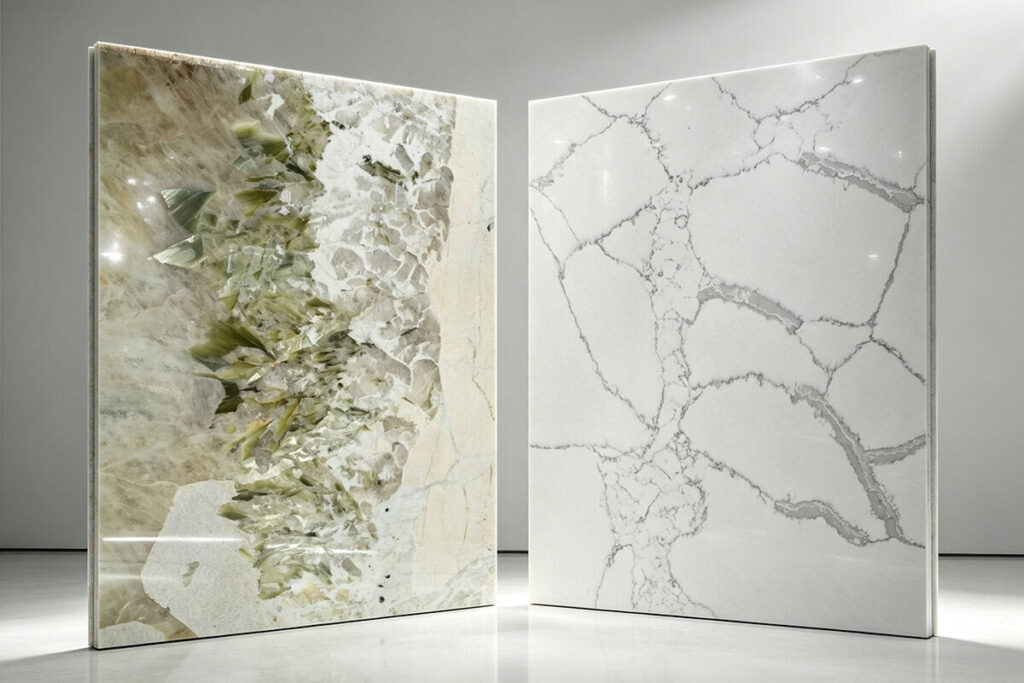
Most homeowners renovating a full home hit the same question partway through: where does quartzite make sense, and where does quartz take over? Jackson Stoneworks team member Brandon sat down with a customer after their project wrapped to answer that exact question. The homeowner put quartz vs quartzite countertops side by side and made two different calls for two different parts of the home. Moreover, price and style drove the decision alongside maintenance. Furthermore, the result shows how blending the two materials often works better than committing to one across every surface.
Why Quartzite Won the Kitchen and Master Bath
Quartzite went into the two rooms that carry the most visual weight: the kitchen and the master bathroom. Because quartzite is a natural metamorphic rock, no two slabs are identical. Furthermore, the mineral depth and movement in a quartzite slab is something engineered stone cannot replicate at the same visual scale. The homeowner specifically described choosing quartzite for its natural splendor — and that quality reads best in rooms where guests spend time and notice the surfaces.
According to Wikipedia, quartzite forms when sandstone undergoes intense heat and pressure over millions of years. That process is what gives it density, hardness, and the layered visual complexity that makes it a showcase material. Additionally, quartzite countertops rank harder than marble, which makes them a practical choice for a working kitchen rather than just an aesthetic one. Moreover, the kitchen and master bath are the surfaces seen and touched most — which is where the natural character earns its premium.
Why Quartz Covered the Rest of the Home
Quartz took every other surface in the home. The reasoning came down to two things Brandon named directly: price and maintenance. Specifically, quartz countertops are engineered from natural quartz crystals bound with resin, which makes the finished surface non-porous. Consequently, there’s no sealing, no absorption risk, and no sensitivity to spills that quartzite requires. For secondary bathrooms, utility spaces, and surfaces outside the main living areas, those properties matter more than the natural variation that makes quartzite worth the cost in showcase rooms.
Furthermore, Brandon noted price as a primary factor in the homeowner’s thinking. Because quartzite commands a premium over most quartz options, using it across every surface would have pushed the total budget significantly higher. Instead, the homeowner concentrated it where the visual impact justified the cost. Additionally, that approach is increasingly common in Jackson’s design consultations — pairing a premium natural stone in high-visibility rooms with engineered quartz in secondary spaces.
Quartz vs Quartzite Countertops: How to Make the Call
The quartz vs quartzite countertops decision comes down to four variables. Knowing where you stand on each one narrows the answer quickly.
Natural variation vs. engineered consistency
Quartzite moves and varies from slab to slab. In contrast, quartz is manufactured to a consistent pattern, so the color and veining read the same across every section ordered. Both approaches have advantages depending on the room. However, in areas where countertop sections need to match across a run — like a long perimeter or multiple adjacent surfaces — quartz is easier to work with.
Maintenance commitment
Quartzite requires periodic sealing to protect against staining, especially in a kitchen. Quartz, however, requires neither sealing nor specialty stone cleaners. As a result, the difference in daily upkeep between the two materials is real and compounds over years of use. Furthermore, families with active kitchens or young children often favour quartz for exactly that reason.
Budget
Quartzite slabs are priced based on rarity, origin, and movement quality. Additionally, because each slab is unique, pricing varies more widely than with engineered stone. Quartz, on the other hand, is more consistently priced across similar colour families. Therefore, homeowners working to a fixed budget find quartz easier to plan around without sacrificing the look they want.
Resale value
Both materials add value, but they do so differently. Quartzite reads as a luxury upgrade and tends to appeal to buyers who recognize natural stone. Similarly, quartz appeals to buyers who prioritize durability and low maintenance. Consequently, a mixed-material approach covers both buyer profiles rather than narrowing the home’s appeal to one preference.
| Factor | Quartz | Quartzite |
|---|---|---|
| Origin | Engineered — natural quartz + resin | Natural metamorphic rock |
| Sealing required | No | Yes, periodic |
| Pattern consistency | Same slab to slab | Unique, varies per slab |
| Price | Entry-level to premium by brand | Mid-range to high based on rarity |
| Heat resistance | Moderate — avoid prolonged direct heat | Higher — better near-range tolerance |
| Maintenance | Low — wipe clean | Moderate — seal and protect from acid |
| Best rooms | All surfaces, especially secondary areas | Kitchen, master bath, statement spaces |
Care and Maintenance: The Real-World Difference
Caring for quartz
Daily quartz care is minimal. Because quartz is non-porous, spills wipe up cleanly without penetrating the surface. Additionally, it doesn’t require any sealers, oils, or specialty stone products. Moreover, standard dish soap and a soft cloth handle the full cleaning routine for most installations. The one caution is heat: avoid placing hot pots or pans directly on quartz without a trivet. Prolonged direct heat can stress the resin binder in the slab over time.
Caring for quartzite
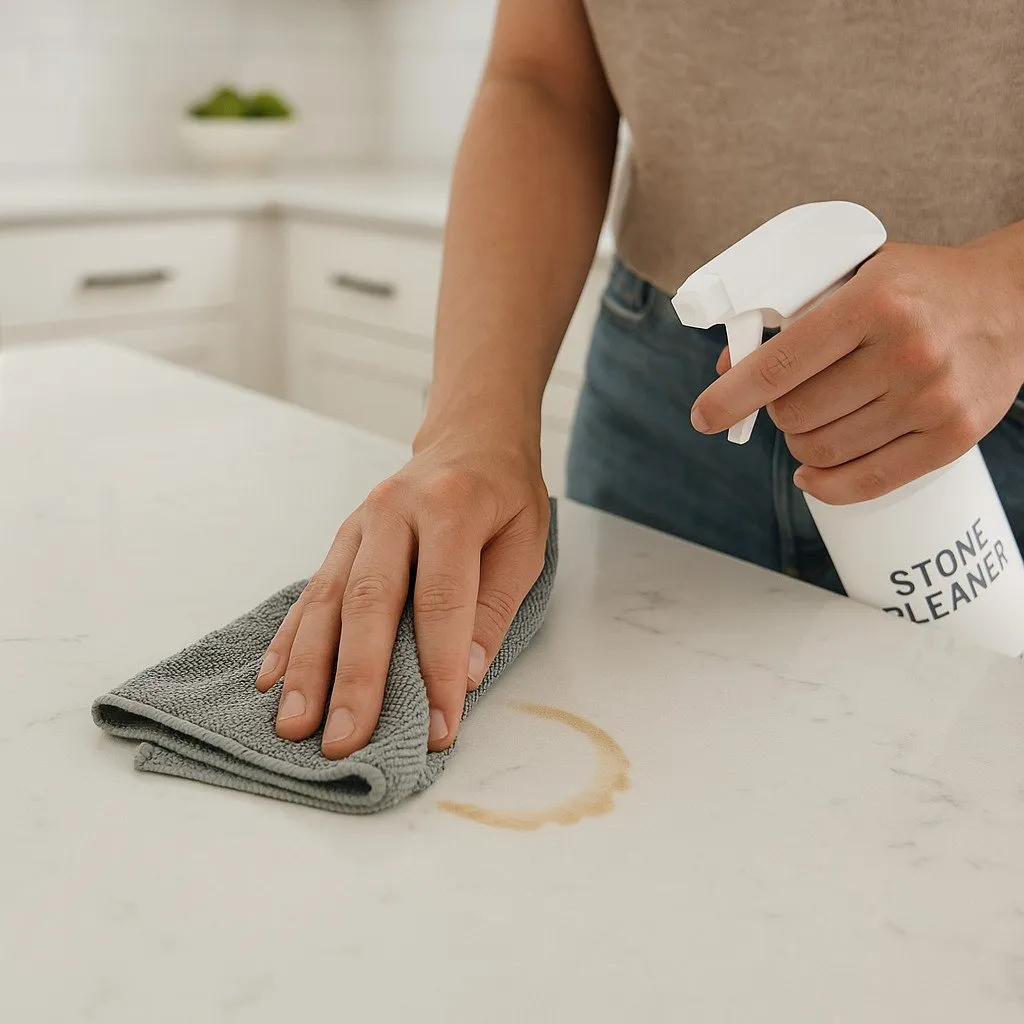
Quartzite requires more attention than quartz, but it’s not demanding once the routine is established. Specifically, it needs to be sealed at installation and resealed annually, or whenever water stops beading visibly on the surface. However, the day-to-day cleaning is the same as any countertop: a pH-neutral cleaner and a soft cloth. In addition, avoid acidic products on quartzite surfaces. Citrus, vinegar, and abrasive cleaners can dull the finish over repeated use. Furthermore, cleaning spills promptly protects the stone between sealing intervals.
Frequently Asked Questions
Is quartzite harder than quartz?
Yes, with a nuance. Natural quartzite typically rates between 7 and 8 on the Mohs hardness scale. In contrast, engineered quartz rates around 7. However, quartzite’s hardness varies by slab origin and mineral composition, so not every quartzite performs identically. Additionally, hardness measures scratch resistance but not porosity — which is where quartz’s non-porous surface holds a functional edge for kitchen use.
Can I mix quartz and quartzite countertops in the same home?
Yes, and this project proves it. Mixing the two materials intentionally gives homeowners natural stone character in high-visibility rooms and the low-maintenance properties of quartz in secondary spaces. Moreover, because both materials can be paired visually through undertone and finish, a mixed-material home doesn’t feel disjointed. Jackson’s design team helps match options across rooms so the surfaces read as a single cohesive decision. The room visualizer on Jackson’s website is also useful for previewing combinations before visiting the showroom.
Which material is better for a kitchen countertop in Florida?
Both work well in Florida kitchens. Quartz handles humidity well and requires no sealing, which suits the year-round heat of a busy household. Quartzite, however, brings a natural depth that suits showcase kitchens where the surface anchors the room’s design. Furthermore, both materials are available for in-person comparison at Jackson’s Gainesville showroom — full slabs, not chips, so the scale reads correctly before you commit.
See Both Options Before You Decide
Brandon’s breakdown reflects what Jackson’s design team does on every project: match the material to how the space will actually be used. When the quartz vs quartzite countertops question comes up, the answer depends on room, lifestyle, and budget working together. Moreover, seeing both as full slabs in the showroom resolves most uncertainty faster than any photo comparison can. Consequently, most homeowners who visit Jackson leave with a clear direction.
Browse the quartz and quartzite selections online, or check the inventory for current in-yard stock. Book a free consultation or call 352-372-6600.


