

There’s a moment on every install where the truck is unloaded, the template is in hand, and the house goes quiet. Because what comes next requires full attention from every person on the crew. The countertop installers Gainesville FL homeowners see on install day are the same team that fabricated the stone at the Jackson Stoneworks facility. Moreover, no job gets handed off between strangers at any point in the process. Furthermore, what looks straightforward from the outside involves a level of precision that only becomes visible when something goes slightly wrong — and the team has to solve it in the field without leaving a trace.
The Scene: What Install Day Actually Looks Like
The truck arrives loaded. Slabs are wrapped, templated, and cut to specification from the Jackson facility. They’re routed, shaped, polished, and edge-profiled before they ever leave the shop. Additionally, sink cutouts are precision-drilled in-house, not on-site, which means the fit either lands perfectly or it doesn’t. Because the fabrication is done with CNC equipment before the crew ever pulls up to the house, there’s very little tolerance for error on either end.
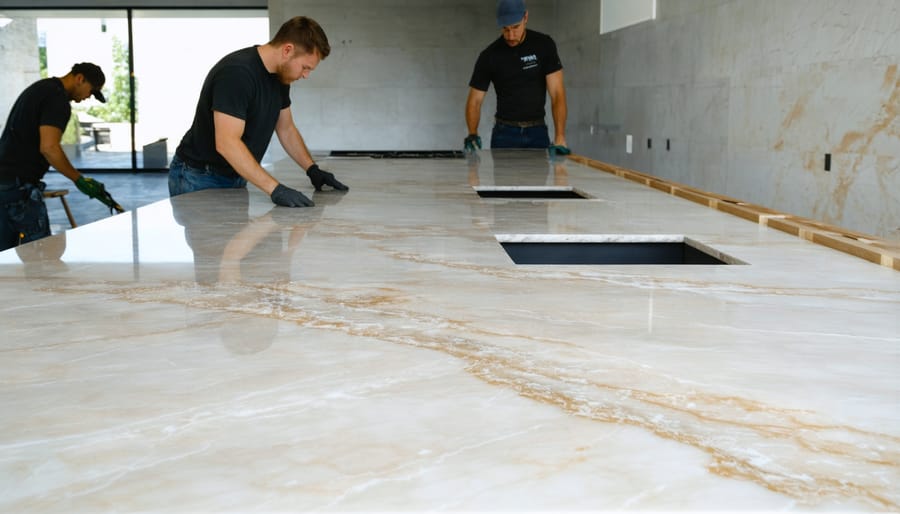
In a typical Gainesville job, the countertop installers Gainesville FL homeowners schedule handle everything from load-in to final polish. Specifically, that includes setting stone level across the cabinet run, seaming pieces where kitchen layout requires it, dropping the undermount sink into a pre-cut opening, and finishing exposed edges to match the profile chosen at the showroom. Moreover, bathrooms add their own challenges: vanity tops in tight hallways, back-to-back installations in Jack and Jill layouts, and double-sink vanities where the cutout spacing has to be exact. Furthermore, each material behaves differently under the tools and the weight — and the crew knows that before the first piece comes off the truck.
The Challenge: What Makes This Work Harder Than It Looks
Stone is heavy, and countertop installers Gainesville FL crews move it by hand. A standard granite slab runs roughly 18 to 20 pounds per square foot. Additionally, a full kitchen perimeter can easily move 400 to 600 pounds of material through doorways, around corners, and into spaces that weren’t designed with a stone crew in mind. Furthermore, older Florida homes present specific complications: doorways narrower than today’s standard, transitions between rooms that don’t sit flush, and cabinets that look level but measure out at an eighth-inch variance over a long run.
According to Wikipedia, stonemasonry as a craft has always required both physical skill and geometric precision — not one or the other. That’s still true on a modern countertop install. Moreover, seaming is where that combination shows most clearly. Specifically, a seam placed incorrectly reads as a line across the entire surface. Placed well, it disappears entirely. The fabrication and installation process at Jackson accounts for seam placement during the templating stage, not as an afterthought on install day. Consequently, the crew arrives knowing exactly where each joint falls and how the grain should transition across it.
Quartzite adds another layer of complexity because it’s a natural stone with unpredictable internal structure. Additionally, quartz requires careful handling near the sink cutout where the engineered slab is most vulnerable to stress fracture during placement. Therefore, the crew approach varies by material. That knowledge comes from doing this work every day, not from a manual.
The Craft: What “Advanced Manufacturing” Means on the Ground
Jackson describes itself as an advanced manufacturer — and that term matters when it reaches the install. Because the shop handles routing, shaping, polishing, leathering, core holes, and drop-out sink cutouts with precision equipment before the slab ships, the crew on-site doesn’t have to improvise. Moreover, field modifications are rare because the template was accurate, the cut was tight, and the edge profile is already finished. Furthermore, when they do need to make a field adjustment, the team has the skill to do it cleanly.
What Precision Looks Like at the Finish Line
The pride in that approach is visible in the work. Specifically, a properly set seam is invisible at standing height. Polished edges catch light evenly across their full length. Every leveled surface sits without rocking, and an undermount sink sits flush to its opening without gaps. Additionally, none of those outcomes happen by accident. Consequently, they reflect a crew that cares about the result at the point of installation as much as the fabrication team did in the shop.
| Stage | What Happens | Why It Requires Skill |
|---|---|---|
| Load-in | Slabs transported from truck to install location | Weight, fragility, tight hallways and doorways |
| Leveling | Stone set level across cabinet run | 1/8 inch variance over 8 feet is the tolerance limit |
| Seaming | Pieces joined at designated seam points | Grain match and joint tightness affect final appearance |
| Sink drop | Pre-cut undermount sink opening seated | Cutout must be precise — stress fractures happen here |
| Edge finish | Any exposed field edge touched up to match profile | Consistency with shop polish is the goal |
| Final set | Adhesive, supports, and caulk applied and cured | Sets the long-term stability of the installation |
What to Ask Your Countertop Installers Before Install Day
The install goes smoother when the homeowner is prepared. These questions narrow the gap between expectation and the finished surface.
Who does the actual installation — your crew or a subcontractor?
When you hire countertop installers Gainesville FL residents depend on, that question matters. Jackson’s installation is done entirely in-house. Specifically, the same crew that fabricated the stone handles the install. Furthermore, that continuity means the people placing the countertop know exactly how it was made and where any tolerances were set during fabrication. In contrast, third-party subcontractors receive finished stone with no direct knowledge of how the template measurements were taken.
What do I need to clear before the crew arrives?
Clear the countertop surface and the cabinet interiors beneath the install area. Additionally, remove anything fragile from nearby shelves or surfaces. Vibration from drilling and grinding travels through walls and cabinetry. Moreover, ensure the space has clear access from the front door to the kitchen or bathroom, including removing any doors that might restrict a slab from passing through at an angle.
What happens if a piece doesn’t fit on the day?
It’s rare when the template was accurate. However, minor field adjustments do happen. The Jackson crew carries the equipment and skills to make clean on-site modifications when needed. Furthermore, because the fabrication is precise, any field adjustment is small rather than structural. Consequently, an install that needs a minor adjustment finishes the same day the same as one that doesn’t.
On the Day Itself
Can I be home during the install?
Yes, and most homeowners are. Additionally, being present means you can approve the seam placement visually before adhesive is set and confirm the sink fits the opening as expected. Moreover, the crew will walk you through the finished surfaces before they pack up, which is the best time to note anything while they’re still on-site.
Frequently Asked Questions
How long does a typical countertop installation take?
Most kitchen installs complete in one day. Specifically, the countertop installers Gainesville FL homeowners book typically finish a straightforward kitchen perimeter with one undermount sink in three to five hours, including load-in, setting, seaming, and final polish. Additionally, bathrooms typically run one to two hours per vanity. Moreover, homes with complex layouts, multiple rooms, or heavy stone materials take longer. The Jackson team plans the schedule before arriving so the timeline is known upfront.
Do countertop installers in Gainesville FL need the cabinets to be finished first?
Yes. Countertops are installed after cabinets are set, plumbing rough-in is complete, and the cabinet surface is clean and level. Furthermore, the template measurement happens after cabinets are in place — not before. Consequently, any cabinet adjustment after templating may require a re-template before the stone can be cut. Coordinating with your cabinet installer and plumber before booking the template appointment avoids that scenario.
Where can I see the quality of Jackson’s finished installations?
The gallery on Jackson’s website shows completed kitchen and bathroom projects across different materials and layouts. Additionally, visiting the showroom gives you a direct look at edge profiles, seam samples, and finish quality in person. Furthermore, the design team is on hand to explain what specific details look like at full scale. Seeing it in person is always more useful than a photo.
Meet the Countertop Installers Gainesville FL Homeowners Keep Coming Back To
The Jackson Stoneworks install crew has handled this work since 2002. Moreover, the same in-house operation that fabricates the stone places it in your home — no handoffs, no subcontractors, no gap between what was templated and what gets installed. Furthermore, every surface that leaves the shop was routed, shaped, polished, and cut by the same team whose reputation depends on how it looks on install day. Consequently, the standard doesn’t drop between fabrication and install. It carries through to the finished surface.
See completed projects in the gallery or book a free consultation to start your own. Jackson Stoneworks is open Monday through Friday 8 AM to 5 PM and Saturday 9 AM to 2 PM. Call 352-372-6600.


